What GBB/ABB are meant for
ACF_GBB (Generic Byte Bus, chapter 9.4.14) and ACF_ABB (Abbreviated Byte
Bus, chapter 9.4.15) don’t carry field-bus-specific semantics like ACF_CAN
or ACF_LIN — instead, they model a generic request/response transaction
scheme that can be mapped onto arbitrary byte-oriented bus protocols.
The exact meaning of individual header bits ( |
Header fields at a glance
| Field | Width | Presumed meaning (from the field name) |
|---|---|---|
| 11 bits | Identifies the bus instance — same width as |
| 64 bits ( | As with |
| 4 bits | Event/message type within the generic transaction |
| 1 bit | Handshake flag — presumably confirms a bus transaction at the protocol level (analogous to an ACK bit) |
| 1 bit | Chip-select flag — hints at a target audience of SPI-like bus protocols with a physical chip-select line |
| 8 bits | A correlation ID to unambiguously match a response to its request |
| 1 bit | Operation — presumably read vs. write access |
| 1 bit | Marks the message as a response (rather than a request) |
| 1 bit | Error flag for the transaction |
| 1 bit | "More Segments" — as with |
| 12 bits | A dual-purpose field — the requested size on a read request, the segment number on a (fragmented) response |
The interplay of |
ACF_ABB: the same structure without a timestamp
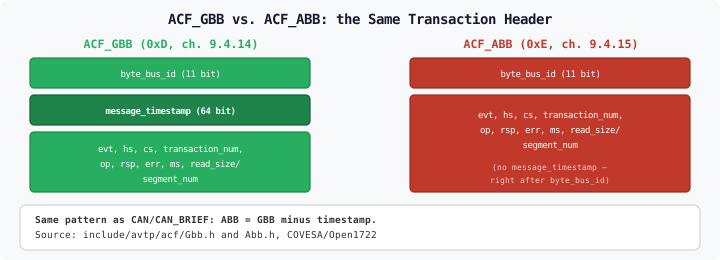
ACF_ABB carries exactly the same transaction fields as ACF_GBB, but
drops message_timestamp — the same pattern as CAN/CAN_BRIEF or
CAN_XL/CAN_XL_BRIEF. For generic bus transactions where no time relation
is evaluated, that saves eight bytes per message.
Why this matters for niche automotive protocols
In practice, a zonal controller occasionally runs into bus systems for which there’s no established ACF format — whether that’s a vendor-specific diagnostic protocol, a sensor with a proprietary register access scheme, or a legacy protocol from a bought-in module. GBB/ABB provide a way out for exactly this case, without having to wait for a dedicated ACF format to be standardized first.
GBB/ABB are a generic fallback, not a replacement for a dedicated format.
Where a specific ACF format exists ( |
Summary
| Aspect | Key takeaway |
|---|---|
ACF_GBB / ACF_ABB | A generic request/response transaction format for bus systems without their own ACF format |
Header fields |
|
ABB vs. GBB | Same pattern as CAN_BRIEF vs. CAN — ABB drops the timestamp |
Use case | A fallback for niche protocols without a dedicated ACF format — not a replacement for CAN/LIN/FlexRay/MOST where those exist |
Status in AUTOSAR | Not specified (as of R24-11) — like all 2025 additions from Part 6 |
Back to the series overview: IEEE 1722 Part 1 — Fundamentals