Part 6
named CAN_V2, CAN_BRIEF_V2, and LIN_V2 as new format versions from IEEE
1722-2025 not included in AUTOSAR. This part clarifies what actually changes
in the V2 formats — and corrects an inaccuracy from Part 6: CAN_V2 and
CAN_BRIEF_V2 have long been implemented in Open1722, only LIN_V2 hasn’t.
Correction to Part 6: it described |
ACF_CAN_V2: the same content, more bus IDs
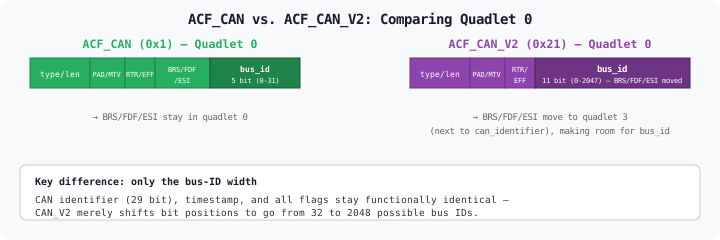
The difference between ACF_CAN (chapter 9.4.1, since 2016) and
ACF_CAN_V2 (chapter 9.4.3, new in 2025) is surprisingly small — and
exactly for that reason practically relevant:
| Field | ACF_CAN | ACF_CAN_V2 |
|---|---|---|
| 5 bits (0-31) | 11 bits (0-2047) |
CAN identifier | 29 bits | 29 bits (unchanged) |
Timestamp | 64 bits | 64 bits (unchanged) |
| Quadlet 0 | Quadlet 3 (moved to make room for |
All functional capabilities (CAN identifier width, timestamp, CAN FD flags)
stay identical between |
5 bits (32 bus IDs) are sufficient for most single-vehicle projects with a manageable number of CAN subnets. The need for 2048 bus IDs arises more in scenarios where a central gateway serves many different vehicle variants or platforms, each with its own CAN-subnet numbering, over a shared TSN backbone — a scenario that becomes more realistic as platform consolidation increases. |
ACF_CAN_BRIEF_V2: the compact variant
Analogous to ACF_CAN_BRIEF versus ACF_CAN, ACF_CAN_BRIEF_V2 (chapter
9.4.4) drops the timestamp — with the same expanded 11-bit bus ID as
ACF_CAN_V2. For event-driven CAN messages with no time relation (see the
TSCF/NTSCF classification in
Part 2),
this is the obvious choice once more than 32 bus IDs are needed.
LIN_V2: defined, but not implemented anywhere yet
Consistently, the standard also provides for a revised LIN format version
with LIN_V2 (0x23) — analogous to the CAN family. At the time of this
research, though, there’s no implementation for it, neither in Open1722
nor in AUTOSAR. That’s a difference from CAN_V2/CAN_BRIEF_V2, which are
at least usable in Open1722 already.
Anyone planning around |
Summary
| Aspect | Key takeaway |
|---|---|
ACF_CAN_V2 | Identical content to ACF_CAN, but 11 instead of 5 bits for bus ID (2048 instead of 32 possible values) — already implemented in Open1722 |
ACF_CAN_BRIEF_V2 | Like ACF_CAN_V2, but without a timestamp — for event-driven messages with many bus IDs |
LIN_V2 | Defined in the standard, but (as of this research) not implemented in either implementation |
Practical relevance | Increases with the number of distinct CAN subnets a central gateway has to serve simultaneously |
Next in the series: IEEE 1722 Part 9 — Generic & Abbreviated Byte Bus (GBB/ABB)