Part 6
called out CAN_XL as the practically most relevant gap between IEEE
1722-2025 and the AUTOSAR module IEEE1722Tp. This part goes deeper: what
exactly does ACF_CANXL (chapter 9.4.18) offer over classic ACF_CAN, and
why is the extra complexity worth it for modern zonal architectures?
Why CAN-XL in the first place?
CAN-XL is the third generation of the CAN bus family (after classic CAN and CAN FD) — with up to 2048 bytes of payload per frame, compared to 8 bytes for classic CAN or 64 bytes for CAN FD. The motivation: in zonal architectures, zonal controllers increasingly need to bundle data that used to be spread across multiple individual CAN frames (e.g. aggregated sensor data) — CAN-XL closes the bandwidth gap between classic CAN and Ethernet, without having to migrate straight to native Ethernet.
CAN-XL itself is a Bosch specification, not an IEEE 1722 concept — IEEE
1722-2025 merely defines |
New header fields compared to ACF_CAN
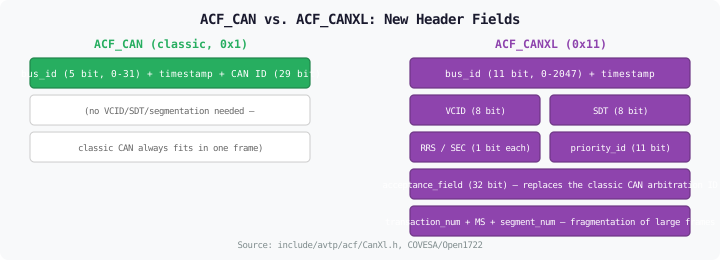
| Field | Width | Meaning |
|---|---|---|
| 11 bits (vs. 5 bits for | The exact same jump as for |
| 8 bits | A CAN-XL-specific concept for virtual network segmentation — multiple logical CAN-XL networks can share the same physical bus |
| 8 bits | Describes how to interpret the payload — CAN-XL itself is deliberately
payload-agnostic, |
| 1 bit each | Reserved/control bits from the CAN-XL frame format itself |
| 11 bits | Prioritization — the successor concept to classic CAN arbitration, which works differently for CAN-XL |
| 32 bits | Replaces the classic CAN arbitration ID as the filter/addressing field |
| 8 / 1 / 12 bits | Segmentation — a CAN-XL frame with up to 2048 bytes of payload can be
larger than what fits into a single AVTPDU, and then has to be segmented
across multiple ACF messages ( |
The segmentation fields ( |
ACF_CAN_XL_BRIEF: the same logic as CAN_BRIEF
Analogous to the ACF_CAN → ACF_CAN_BRIEF relationship, there’s also a
Brief variant for CAN-XL (ACF_CAN_XL_BRIEF, chapter 9.4.19): identical
field structure, but without the 64-bit timestamp — VCID moves directly
behind the common header. For applications that don’t need a timestamp,
that saves 8 bytes per message.
The rule of thumb from the classic |
Why this is missing from AUTOSAR
As classified in
Part 6:
CAN_XL and CAN_XL_BRIEF are new additions from IEEE 1722-2025 itself —
an AUTOSAR release specified before these chapters were finally standardized
simply can’t contain them yet. For a project that wants to tunnel CAN-XL
subnets via ACF, the only current option is a proprietary extension or
waiting for a future AUTOSAR release.
Summary
| Aspect | Key takeaway |
|---|---|
CAN-XL | Third CAN generation, up to 2048 bytes of payload — closes the bandwidth gap between CAN and Ethernet |
New fields vs. ACF_CAN |
|
Segmentation | A core part of the format, not optional — CAN-XL frames can be larger than a single ACF message |
CAN_XL_BRIEF | Same logic as CAN_BRIEF — no timestamp, more compact header |
Status in AUTOSAR | Not specified (as of R24-11) — purely a matter of release timing, not a fundamental incompatibility |
Next in the series: IEEE 1722 Part 8 — CAN_V2, CAN_BRIEF_V2 & LIN_V2