The previous five parts covered AVTP, ACF, and the ARXML configuration of the
AUTOSAR module IEEE1722Tp — and repeatedly noted that AUTOSAR only
implements a slice of what the general IEEE 1722-2025 standard actually
describes. This part makes that slice explicit: which AVTPDU subtypes and
ACF message types does the standard know that simply don’t appear in the
AUTOSAR module (as of R24-11)?
This is based on the header files from
COVESA/Open1722
( |
AVTPDU subtypes: the full standard vs. the AUTOSAR module
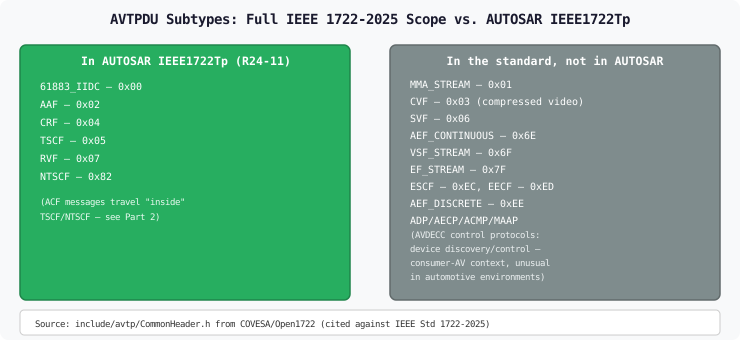
| Subtype | Value | In the AUTOSAR module? |
|---|---|---|
|
| Yes — |
|
| No |
|
| Yes — |
|
| No — as noted in Part 1:
AUTOSAR uses only |
|
| Yes — |
|
| Yes — as a frame for ACF messages (see Part 2) |
|
| No |
|
| Yes — |
|
| No |
|
| Yes — as a frame for ACF messages (see Part 2) |
|
| No |
|
| No |
|
ACF message types: Table 22 in detail
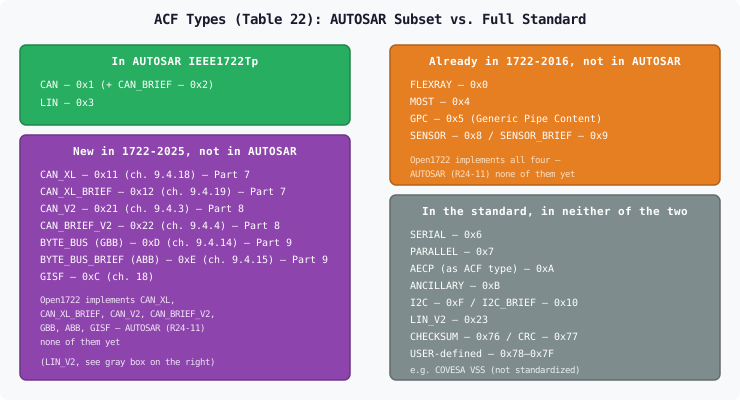
The ACF type list (Avtp_AcfMsgType_t in AcfCommon.h, cited against "IEEE
Std 1722-2025 table 22") is considerably richer than
Part 2
suggested. Four groups can be distinguished:
In the AUTOSAR module
| Type | Value |
|---|---|
|
|
|
|
Already in IEEE 1722-2016, but not in AUTOSAR
| Type | Value | Note |
|---|---|---|
|
| Implemented by Open1722 ( |
|
| Also in the standard since 2016, also not in AUTOSAR |
|
| Generic tunnel for arbitrary pipe/stream data with no dedicated format |
|
| Generic sensor data packet tunneling |
New in IEEE 1722-2025, not in AUTOSAR
These are the actually interesting additions — formats that didn’t exist at all in the 2016 revision:
| Type | Value | Note |
|---|---|---|
|
| Tunnels CAN-XL frames — including a VCID (Virtual CAN Network ID) and SEC field, both CAN-XL-specific concepts that don’t exist for classic CAN/CAN FD (details in Part 7) |
|
| Reduced header for CAN-XL, analogous to |
|
| New, revised format versions with a considerably wider bus-ID field (11
instead of 5 bits) — already implemented by Open1722 ( |
|
| Present in the standard’s type enum, but (as of this research) not yet implemented in either implementation (Open1722, AUTOSAR) |
|
| Generic Byte Bus — a tunnel for arbitrary byte-array protocols with request/response semantics (see Part 9) |
|
| Abbreviated Byte Bus — a variant of GBB without the timestamp field (see Part 9) |
|
| Generic Image Sensor Format — its own chapter in the standard, for raw
image data straight from the image sensor (not to be confused with |
|
Implemented in neither Open1722 nor AUTOSAR
| Type | Value |
|---|---|
|
|
|
|
|
|
|
|
|
|
|
|
Vendor-specific ( |
|
The vendor-specific range ( |
Why these gaps (probably) exist
None of the gaps listed are surprising once you consider the context AUTOSAR CP R24-11 was specified in:
| Reason | Affects |
|---|---|
Release timing |
|
Missing automotive use case (so far) |
|
No automotive use case (fundamentally) |
|
None of this is a guarantee that a future AUTOSAR release will add these formats — it’s merely a plausible explanation for why they’re currently missing. Anyone depending on one of these types (CAN_XL above all) should explicitly raise it with AUTOSAR as an extension request, not count on automatic inclusion in the next release. |
Summary
| Aspect | Key takeaway |
|---|---|
AVTPDU subtypes | AUTOSAR covers 6 of roughly 19 subtypes ( |
ACF types | AUTOSAR only covers |
Most practically relevant gap |
|
What AUTOSAR doesn’t need | The AVDECC control protocols ( |
The following three parts go into the practically most relevant gaps in detail: CAN-XL, CAN_V2/LIN_V2, and Generic/Abbreviated Byte Bus.
Next in the series: IEEE 1722 Part 7 — CAN-XL & CAN-XL Brief