The container hierarchy
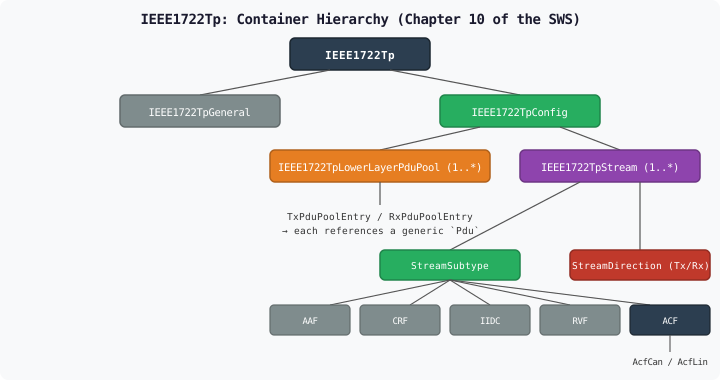
IEEE1722Tp
 ├── IEEE1722TpGeneral                       (0..1)
 │    ├── IEEE1722TpDevErrorDetect
 │    ├── IEEE1722TpVersionInfoApi
 │    ├── IEEE1722TpMainFunctionTx           (Period, PartitionRef)
 │    └── IEEE1722TpMainFunctionRx           (Period, PartitionRef)
 └── IEEE1722TpConfig                        (0..1)
      ├── IEEE1722TpLowerLayerPduPool        (1..*)
      │    ├── IEEE1722TpLowerLayerTxPduPoolEntry (0..*)
      │    │    ├── IEEE1722TpLowerLayerTxPduId
      │    │    └── IEEE1722TpLowerLayerTxPduRef   → Pdu
      │    └── IEEE1722TpLowerLayerRxPduPoolEntry (0..*)
      │         ├── IEEE1722TpLowerLayerRxPduId
      │         └── IEEE1722TpLowerLayerRxPduRef   → Pdu
      └── IEEE1722TpStream                   (1..*)
           ├── IEEE1722TpStreamIdUniquePart
           ├── IEEE1722TpStreamIdMacAddress   (0..1)
           ├── IEEE1722TpStreamIndex
           ├── IEEE1722TpStreamMaxTransitTime
           ├── IEEE1722TpStreamVersion
           ├── IEEE1722TpEthIfClkUnitRef
           ├── IEEE1722TpStbMSynchronizedTimeBaseRef
           ├── IEEE1722TpStreamLowerLayerPduPoolRef  → IEEE1722TpLowerLayerPduPool
           ├── IEEE1722TpStreamDirection      (Choice: Tx | Rx, each with TxQueue/RxQueue)
           └── IEEE1722TpStreamSubtype        (Choice, exactly 1)
                ├── IEEE1722TpStreamAAF
                ├── IEEE1722TpStreamCRF
                ├── IEEE1722TpStreamIIDC
                ├── IEEE1722TpStreamRVF
                └── IEEE1722TpStreamACF
                     ├── IEEE1722TpStreamAcfHeaderType (TIME_SYNCHRONOUS | NON_TIME_SYNCHRONOUS)
                     ├── IEEE1722TpAcfCollectionThreshold
                     ├── IEEE1722TpAcfCollectionTimeout
                     ├── IEEE1722TpStreamAcfMixedBusTypeCollection
                     └── IEEE1722TpStreamAcfPayload (Choice, 1..*)
                          ├── IEEE1722TpStreamAcfCan   → IEEE1722TpStreamAcfCanPdu (1..*)
                          └── IEEE1722TpStreamAcfLin
The module supports all three post-build variants ( |
The key parameters of IEEE1722TpStream
| Parameter | Meaning |
|---|---|
| Together they form the stream ID per IEEE 1722 (MAC address + unique
part) — |
| Handle index for API access in the communication stack — explicitly not the same as the actual stream ID from the two parameters above (see the warning below) |
| Maximum transit time of the stream, in seconds |
| Reference to exactly one |
| References to the time source from which the |
The specification explicitly points out: |
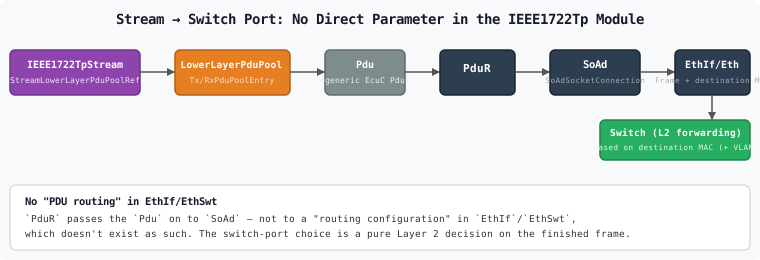
Stream-to-switch-port mapping: indirect, not direct
An obvious assumption would be that an IEEE1722TpStream references a
switch port directly (analogous to EthSwtPortIdx in the
EthSwt ARXML
configuration). That’s not the case:
|
For practical configuration work, this means: the stream-to-port question
can’t be answered within the IEEE1722Tp ARXML at all. PduR routes the
Pdu to SoAd, SoAd maps it to a socket connection
(SoAdSocketConnection), which in turn is bound to EthIf/Eth — only on
the finished Ethernet frame does the switch decide, based on the
destination MAC address (and VLAN membership, if any), which port to
forward it out of. That’s a configuration layer completely separate from
the IEEE1722Tp ARXML.
Example configuration: an ACF_CAN transmit stream
Illustrative (container and parameter names are real, concrete values are made up) — a stream that transmits CAN messages via NTSCF:
<IEEE1722TP-STREAM>
  <SHORT-NAME>Stream_AcfCan_Tx_Zone1</SHORT-NAME>
  <IEEE1722TP-STREAM-ID-UNIQUE-PART>1</IEEE1722TP-STREAM-ID-UNIQUE-PART>
  <IEEE1722TP-STREAM-INDEX>0</IEEE1722TP-STREAM-INDEX>
  <IEEE1722TP-STREAM-MAX-TRANSIT-TIME>0.002</IEEE1722TP-STREAM-MAX-TRANSIT-TIME>
  <IEEE1722TP-STREAM-VERSION>0</IEEE1722TP-STREAM-VERSION>
  <IEEE1722TP-STREAM-LOWER-LAYER-PDU-POOL-REF DEST="IEEE1722TP-LOWER-LAYER-PDU-POOL">
    /IEEE1722Tp/IEEE1722TpConfig/PduPool_Zone1_Tx
  </IEEE1722TP-STREAM-LOWER-LAYER-PDU-POOL-REF>
  <IEEE1722TP-STREAM-DIRECTION>
    <IEEE1722TP-STREAM-TX/>
  </IEEE1722TP-STREAM-DIRECTION>
  <IEEE1722TP-STREAM-SUBTYPE>
    <IEEE1722TP-STREAM-ACF>
      <IEEE1722TP-STREAM-ACF-HEADER-TYPE>NON_TIME_SYNCHRONOUS</IEEE1722TP-STREAM-ACF-HEADER-TYPE>
      <IEEE1722TP-ACF-COLLECTION-THRESHOLD>256</IEEE1722TP-ACF-COLLECTION-THRESHOLD>
      <IEEE1722TP-ACF-COLLECTION-TIMEOUT>0.001</IEEE1722TP-ACF-COLLECTION-TIMEOUT>
      <IEEE1722TP-STREAM-ACF-MIXED-BUS-TYPE-COLLECTION>false</IEEE1722TP-STREAM-ACF-MIXED-BUS-TYPE-COLLECTION>
      <IEEE1722TP-STREAM-ACF-PAYLOAD>
        <IEEE1722TP-STREAM-ACF-CAN>
          <IEEE1722TP-STREAM-ACF-BUS-ID>1</IEEE1722TP-STREAM-ACF-BUS-ID>
          <IEEE1722TP-STREAM-ACF-CAN-MESSAGE-TYPE>CAN</IEEE1722TP-STREAM-ACF-CAN-MESSAGE-TYPE>
        </IEEE1722TP-STREAM-ACF-CAN>
      </IEEE1722TP-STREAM-ACF-PAYLOAD>
    </IEEE1722TP-STREAM-ACF>
  </IEEE1722TP-STREAM-SUBTYPE>
</IEEE1722TP-STREAM>
|
Typical configuration mistakes
| Mistake | Effect |
|---|---|
Confusing | API calls fail, or address the wrong stream, even though the wire-format ID is configured correctly |
| The stream can’t be sent/received — the error often only shows up at runtime, not already during ARXML validation |
|
|
Downstream configuration ( | The stream is generated correctly but delivered nowhere, or with the wrong
destination MAC address — since |
Summary
| Aspect | Key takeaway |
|---|---|
Container hierarchy |
|
Stream ID vs. stream index | Two independent identifiers — confusing them is a common pitfall the specification explicitly calls out |
Switch-port mapping | No direct parameter in the |
Next step | Part 4 shows end-to-end practical examples, followable with Open1722 |
Next in the series: IEEE 1722 Part 4 — End-to-End Practical Examples with Open1722