Zonal architectures with switches increasingly rely on TSN mechanisms (IEEE 802.1Q) to guarantee hard real-time behavior for individual streams. This post covers the two central AUTOSAR building blocks for that: egress scheduling/shaping and frame preemption.
Why scheduling in the switch is needed at all
Multiple streams compete for the same bandwidth on the same egress port. Without prioritization, a best-effort bulk transfer (e.g. a diagnostic data upload) could block a hard real-time deadline of a safety stream (e.g. a brake signal).
Egress queues, transmission selection and port schedulers
Frames are enqueued into egress queues (EthSwtPortQueue) according to
their traffic class assignment. Each queue has a mandatory sub-container
EthSwtPortEgressQueueTransmissionSelection, which determines via
EthSwtPortEgressQueueTransmissionSelectionAlgorithm how frames are
selected for transmission from that queue — e.g. Credit Based Shaper (CBS)
or Asynchronous Traffic Shaper.
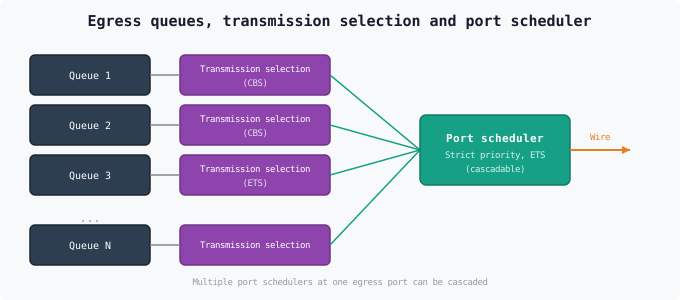
The EthSwtPortEgressScheduler (mandatory sub-container, algorithm via
EthSwtPortSchedulerAlgorithm, e.g. strict priority) then decides which
of the already pre-selected queues actually gets to transmit.
Per the SWS, multiple port schedulers can be cascaded at one egress port: the output of one egress scheduler feeds into the next port scheduler as its input. This allows multi-stage prioritization strategies (e.g. CBS smoothing per queue group first, then strict priority between groups) instead of a single flat scheduler. |
CBS vs. ETS
| Mechanism | Basic idea |
|---|---|
Credit Based Shaper (CBS) | The classic AVB/TSN shaper (IEEE 802.1Qav): a queue accumulates "credit" while transmitting and loses credit while waiting — limits transmit bandwidth to a configured value without fully suppressing bursts |
Enhanced Transmission Selection (ETS) | Bandwidth shares are jointly assigned to multiple traffic classes (IEEE 802.1Qaz) — useful when several classes should share a guaranteed minimum bandwidth instead of a strict ranking |
Frame preemption (IEEE 802.1Q)
Frame preemption is configured per EthSwtPort
(EthSwtFramePreemptionEnable) and requires the switch hardware to
actually support it — it’s disabled by default, since the SWS assumes
switch hardware typically doesn’t support it.
EthSwtFramePreemptionEnable = TRUE  on the port
        │
        ▼
Frames in the EthSwtPortQueues get classified:
  EthSwtTrafficClassToPreemptionStatusAssignment
        ├── ETHSWT_TRAFFIC_CLASS_PREEMPTABLE  → interruptible
        └── ETHSWT_TRAFFIC_CLASS_EXPRESS      → interrupts others
If preemption is active on a port, it applies to both ingress and egress. A frame classified as "express" can then interrupt a "preemptable" frame on the wire (interspersing) — the critical message doesn’t have to wait until the large frame is fully transmitted.
Frame preemption only works link by link: both ends of a connection must support it. The SWS explicitly states that dynamic negotiation of preemption capability between peers via protocols like LLDP is not supported by AUTOSAR — automotive networks are designed statically enough that a system-wide consistent configuration via the system description is sufficient. |
Practical example
An uplink port carries both a hard real-time stream (e.g. brake data, classified as "express") and a diagnostic bulk transfer (classified as "preemptable"). With frame preemption enabled, the brake-data frame can interrupt the ongoing diagnostic frame transfer instead of waiting for it to complete entirely — critical for meeting a hard latency deadline.
Summary
| Aspect | Key takeaway |
|---|---|
Egress scheduling | Queue-based, with cascadable port schedulers (strict priority, ETS) |
Shapers | CBS for AVB-style bandwidth limiting, ETS for shared bandwidth across multiple classes |
Frame preemption | Configurable per port, traffic classes marked as preemptable/express |
Key limitation | Only works link by link; no dynamic LLDP negotiation in AUTOSAR — fully static configuration |