The EthSwt overview article already covered what an AUTOSAR Ethernet Switch Driver does and when you need one instead of a plain EthTrcv. This tutorial series now goes one level deeper: before the next parts cover API calls, ARXML containers and VLAN configuration, this first part clarifies what the official Specification of Ethernet Switch Driver (Document ID 656, AUTOSAR CP R25-11) actually mandates — state machine, configuration classes, and how the module fits into the stack.
Every claim in this post has been checked against the original SWS text
(docs/references/autosar-sws/AUTOSAR_CP_SWS_EthernetSwitchDriver_R25-11.txt
in this blog’s source repository).
The SWS EthSwt at a glance
At roughly 330 pages, the SWS EthSwt is noticeably larger than the SWS EthTrcv — not because a switch is inherently more complex, but because it brings additional functional areas a plain transceiver simply doesn’t have: port mirroring, MAC learning, VLANs, Time-Sensitive Networking (TSN), MACsec at the switch level, and interaction with the Firewall module. This series covers the fundamentals in parts 1–4 and dives into the specialized topics afterwards in dedicated posts.
SWS EthSwt (Document ID 656) — chapter overview
──────────────────────────────────────────────────────────────
1  Introduction and functional overview
5  Dependencies to other modules
7  Functional specification          ← basis of this post
   7.1.1  Indexing scheme
   7.1.2  Port Mirroring
   7.1.3  State Handling             ← state machine
   7.1.7  Functional Description     (Learning, VLAN, TSN, MACsec, ...)
8  API specification                 ← Part 2 of this series
10 Configuration specification       ← Part 3 of this series
The module’s state machine
Contrary to what you might expect, the EthSwt state machine isn’t a simple Uninit/Init pair — it has four stages, explicitly distinguishing between "the driver is initialized" and "the ports are initialized":
EthSwt_StateType (SWS_EthSwt_00123)
──────────────────────────────────────────────────────────────
ETHSWT_STATE_UNINIT              0x00   Switch is not yet configured
        │
        │  EthSwt_Init()
        ▼
ETHSWT_STATE_INIT                0x01   Switch driver is initialized
        │
        │  (port initialization completed)
        ▼
ETHSWT_STATE_PORTINIT_COMPLETED  0x02   Port initialization is completed
        │
        │  EthSwt_SetSwitchPortMode(ACTIVE)
        ▼
ETHSWT_STATE_ACTIVE              0x03   Switch is active
The SWS explicitly describes this state as
"status supervision used for Development Error Detection" — so its
primary purpose is error diagnosis (DET), not application-level flow
control. Still, it’s worth checking first when debugging a bring-up issue:
if the driver is still stuck in |
Configuration classes
Like every AUTOSAR BSW module, EthSwt distinguishes between pre-compile, link-time and post-build parameters. For a switch driver this yields a practically useful rule of thumb:
| Configuration class | Typical for EthSwt |
|---|---|
Pre-compile | Basic module capabilities that affect compile-time code generation —
e.g. whether |
Link-time | Rarely used for EthSwt, usually project-specific library binding |
Post-build | The bulk of practical parametrization: port count, VLAN assignment, MAC learning mode, mirroring configuration — values that differ between vehicle variants without requiring the driver to be recompiled |
According to the SWS, EthSwt_ConfigType (chapter 8.2.2) is explicitly
defined as an "implementation specific structure of the post build
configuration" — the actual structure is up to the MCAL vendor, only its
post-build nature is normative.
The indexing scheme: SwitchIdx and SwitchPortIdx
A detail that’s more often overlooked than you’d think: EthSwt uses two separate, zero-based indices (chapter 7.1.1):
SwitchIdx— identifies which switch is meant, if an ECU has multiple physical switch chipsSwitchPortIdx— identifies a port on that switch
Practically every EthSwt API (see Part 2) therefore takes either both
indices or at least SwitchIdx. Accidentally passing a SwitchPortIdx that
belongs to a different switch under the wrong SwitchIdx won’t produce a
compile error — just wrong behavior on the wrong port.
If an ECU integrates multiple switch chips from different vendors, the SWS
requires ( |
Architecture in the AUTOSAR Ethernet stack
EthSwt sits between EthIf and the EthTrcv instances of the individual
switch ports:
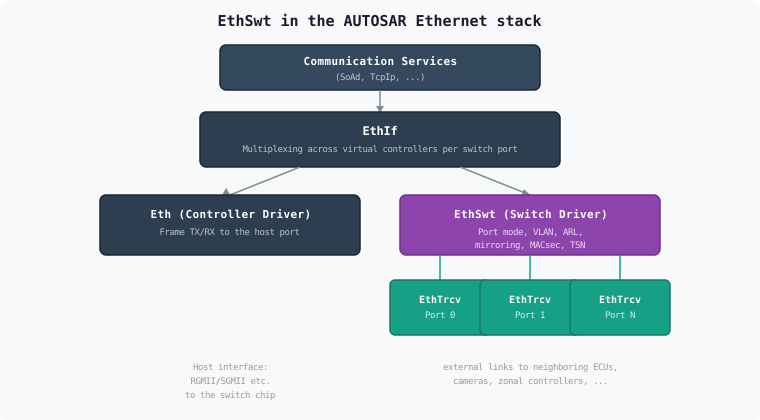
The key difference from a plain EthTrcv setup: EthSwt typically has
multiple EthTrcv instances underneath it — one per external port —
while the host itself talks to the switch over a single Eth/EthIf path.
The switch itself handles forwarding between the external ports without
every frame having to pass through the host.
A useful mnemonic: with a plain |
Multi-switch topologies
Cascaded switches are the norm in zonal architectures: a backbone switch in
the central gateway, connected via uplink ports to smaller switches in the
zonal controllers. The SWS explicitly accounts for this through the port
role ETHSWT_UP_LINK_PORT and dedicated mechanisms for clock
synchronization between cascaded switches (more on that in
issue #142
of this series).
Interaction with EthIf
EthIf abstracts every switch port as its own virtual controller towards
the upper layers — to TcpIp/SoAd, a switch port looks exactly like a
standalone EthTrcv controller. That’s the key trick that frees the higher
communication layers from having to distinguish between "plain transceiver"
and "switch port".
Overview of the series
| Part | Topic |
|---|---|
1 (this post) | Fundamentals, SWS & architecture — state machine, configuration classes, indexing scheme, position in the stack |
2 — API & initialization sequence | The concrete EthSwt function calls and their order |
3 — ARXML configuration | Container structure, mandatory parameters, complete example |
4 — VLAN management, mirroring & diagnostics | Runtime VLAN changes, mirroring, MAC learning, MIB counters |
Several dedicated posts additionally dive into specialized topics: hardware architecture (including the internal switch fabric and switch stacking), TSN (stream identification, time-aware shaping, frame preemption), MACsec in the switch, firewall interaction, global time support, the ARL table/MAC learning, and diagnostics/register access (SPI/SMI).
Summary
| Aspect | Key takeaway |
|---|---|
State machine | Four stages: |
Configuration classes | Practical parametrization (ports, VLANs, mirroring) runs almost exclusively through post-build configuration |
Indexing scheme | Two separate, zero-based indices: |
Architecture in the stack |
|
Next step | Part 2 shows the concrete API and initialization order of |
Next in the EthSwt series: EthSwt Part 2 — API & Initialization Sequence