This blog’s already-completed EthTrcv MACsec series covers MACsec/MKA at the transceiver level. The real SWS EthSwt shows that the switch itself also has a complete MACsec implementation with its own API set — including bypass lists and the same MKA key infrastructure.
Every |
Why MACsec in the switch AND the transceiver?
EthTrcv/MKA secures a single point-to-point link. A switch with multiple
ports can additionally encrypt/decrypt at line rate per port —
relevant when different segments of a zonal network have different trust
levels and the switch itself acts as a security boundary.
Enabling it per port
EthSwtPortMacSecEnabled enables MACsec for a port. If the parameter is
absent or FALSE, the driver ignores all MACsec configuration on that
port entirely and handles frames without any MACsec processing.
Bypass lists
Even with MACsec enabled, certain frames can be selectively exempted from encryption:
| Parameter | Bypass criterion |
|---|---|
| Frames with one of the configured EtherTypes |
| Frames with one of the configured VLAN IDs |
| Frames with one of the configured destination MAC addresses |
Bypass lists are essential in practice for boot and management traffic that has to flow before the MACsec session is even established (i.e. before valid secure associations exist). |
Setting up secure channels and secure associations
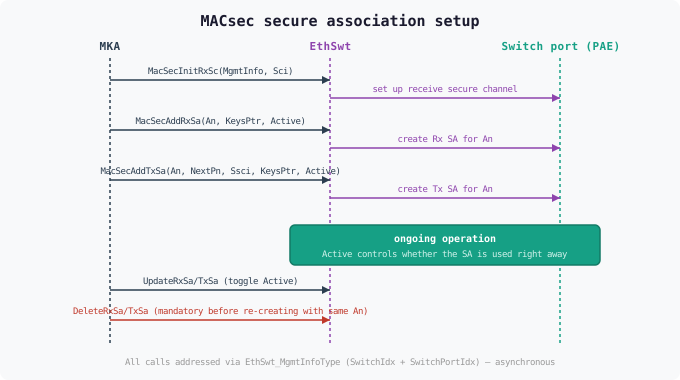
Per the SWS, there may only ever be one secure association per
association number ( |
All of these APIs are addressed via EthSwt_MgmtInfoType
(SwitchIdx+SwitchPortIdx) — the same structure also used by the
switch management support for timestamp metadata (see this series' Global
Time post). Notably, every secure-association function is
asynchronous, hinting at potentially longer hardware access times
during key loading.
Shared key infrastructure with EthTrcv
EthSwt_MacSecAddTxSa/AddRxSa expect a Mka_SakKeyPtrType pointer — the
same type used by the MKA implementation on the EthTrcv side (see the
EthTrcv MACsec post). That confirms: there’s one central MKA instance
generating key material (SAK) — whether the actual encryption/decryption
happens in the transceiver or the switch is purely a matter of hardware
placement, not separate key management.
Statistics and PAE control
EthSwt_MacSecGetMacSecStatisticsprovides MACsec statistics for an MKA participant (Mka_Stats_SecYType)EthSwt_MacSecGetTxSaNextPnreturns the next packet number of a transmit SA — important for replay-protection monitoringEthSwt_MacSecSetControlledPortEnabledenables/disables the PAE’s controlled port (Port Access Entity, IEEE 802.1X concept) — the port through which data traffic may only flow after successful authentication
Summary
| Aspect | Key takeaway |
|---|---|
Activation |
|
SA management | Init/Add/Update/Delete for Rx and Tx secure associations, exactly one
SA per |
Addressing | Via |
Key infrastructure | Shared MKA types ( |